When Mixing Takes Time: Closed-Form Models for Dispersion in Time-Varying Flow
- Colloquium 4:10-5:00 p.m., Spark 212 |
- Open Discussion and Refreshments 3:15 - 4:00 p.m., Neill Hall 216 (Hacker Lounge) |
- Zoom Meeting ID: 987 5255 6017 |
- Zoom Meeting Passcode: 592830 |
- Zoom Meeting Link: https://wsu.zoom.us/j/98752556017?pwd=3cVJCGjKqRYp2jxEiKNGajGAvsi2vL.1
About the event
Department of Mathematics & Statistics Colloquium
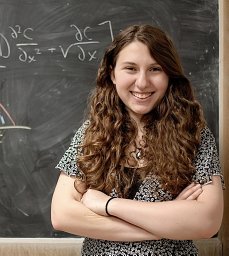
Dr. Sabrina Volponi
Postdoctoral Researcher, Department of Civil Engineering Washington State University
When Mixing Takes Time: Closed-Form Models for Dispersion in Time-Varying Flow
Abstract: When modeling how a dissolved substance moves and spreads in flowing water, two simplifying assumptions are often made: (1) the velocity of the flow is constant and (2) the substance is fully mixed across the cross-section of the domain. The latter assumption allows for spreading to be described using a constant dispersion coefficient. In many real systems, the dispersion coefficient is not constant; it grows over time as the solute gradually samples more of the velocity field, a behavior known as pre-asymptotic dispersion (PAD). Time- and/or distance-dependent dispersion coefficients have historically been used to address PAD but can produce inconsistencies when solute pulses interact, particularly in nonlinear systems where superposition fails. Here we generalize our recent closed-form solution for one-dimensional advective-dispersive transport with PAD to the case of time-varying velocity. This new solution involves expressing dispersion as a function of both solute age in the flow (residence time) and physical time. These solutions apply to both initial and boundary value problems over an infinite domain, including cases with first-order reactions. We validate our boundary value solution by reproducing breakthrough curves from turbulent, accelerating pipe flow experiments. Our results show that a solute’s “memory” of reduced early-time dispersion continues to influence its transport even after complete mixing is achieved. More broadly, this framework fills a critical modeling gap by enabling physically consistent analysis of solute transport under PAD and time-varying flow—conditions common in natural systems but rarely studied together.
Speaker Bio: Sabrina Volponi is a postdoctoral fellow in the Department of Civil Engineering at Washington State University. She obtained her Ph.D. and M.S. in Civil and Environmental Engineering and Earth Sciences at the University of Notre Dame, studying environmental fluid mechanics under the mentorship of Dr. Diogo Bolster. Her broad expertise in transport through streams, fracture networks, and colloidal systems has been shaped by research experiences at Los Alamos National Laboratory, the University of Utah, and the Politecnico di Milano. Her current research at WSU focuses on using pore-scale transport processes to predict water quality at more significant spatial scales.