The School of Mechanical and Materials Engineering Seminar Series, “Biofunctional Implants with Natural Drug Delivery for Bone Regeneration, Tumor Suppression, and Infection Control” Presented by Aditi Dahiya
About the event
Biofunctional Implants with Natural Drug Delivery for Bone Regeneration, Tumor Suppression, and Infection Control
Presented by Aditi Dahiya, Ph.D. Candidate, W. M. Keck Biomedical Materials Research Laboratory, Department of Chemistry, Washington State University
Abstract:
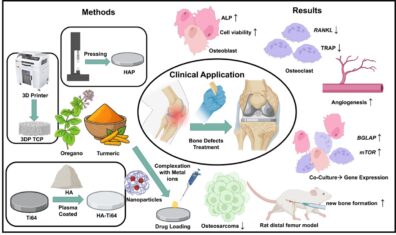
Critical-sized bone defects remain a major clinical challenge due to limited self-regeneration and the shortcomings of traditional grafts. This work presents a materials-centric strategy that uses binder jet 3D-printed tricalcium phosphate (TCP) scaffolds and RF plasma-sprayed hydroxyapatite (HA) coatings on Ti-6Al-4V (Ti64) implants. The TCP scaffolds can have ~50–60% controlled volume fraction porosity to mimic trabecular bone, facilitating nutrient diffusion, vascularization, and osteoblast infiltration. The HA-coated Ti64 implants offer bioactivity due to the coating and mechanical stability from the metallic substrate for load-bearing applications. To impart therapeutic functionality, scaffolds were loaded with phytochemicals such as carvacrol, curcumin, and their derivatives engineered via chemical modification, lipid encapsulation, and metal-ligand complexation for sustained, pH-responsive release. These systems showed around 90% antibacterial efficacy, enhanced osteogenesis, and potent osteosarcoma inhibition without cytotoxicity towards osteoblast cells. Carvacrol-aldehyde, Cu²⁺-Schiff base complexes, and curcumin-Mg²⁺ conjugates significantly boosted osteoblast activity and modulated osteoclastogenesis. Scaffold made from 3DP TCP with 400 µm showed a compressive strength 3 1 MPa, while plasma-sprayed HA coatings achieved tunable thicknesses (80-145 µm) with a coating strength of 26 2 MPa. This work lays a platform that unites additive manufacturing, surface bioactivation, and multifunctional drug delivery to engineer patient-specific implants for complex orthopedic defect repair.
Biography:
Aditi Dahiya is a Ph.D. candidate in Chemistry at Washington State University, working under the mentorship of Dr. Susmita Bose in the W. M. Keck Biomedical Materials Research Laboratory. Originally from New Delhi, India, Aditi earned her bachelor’s in Chemistry (Honors) and Master’s in Chemistry from the University of Delhi. Her current research focuses on developing multifunctional 3D-printed calcium phosphate and titanium-based scaffolds for bone regeneration, functionalized with natural medicinal compounds for controlled drug delivery, antibacterial effects, and osteosarcoma inhibition. Her work spans materials science, drug delivery, and translational tissue engineering, with rigorous in vitro and in vivo validation models, including osteoblasts, osteoclasts, and rat distal femur implants. She has published five peer-reviewed journal articles, such as in Small and Journal of Medicinal Chemistry, and one invited book chapter. Aditi has presented her work at numerous national and international conferences, earning several awards for research excellence and communication, including Ivan J. Legg Graduate Fellowship, Teaching Assistant of the Year, multiple Best Poster Awards at MS&T, and WSU 3-Minute Thesis Competition. For her work as a vice president of the Indian student association, she won the President’s Leadership Award.