The School of Mechanical and Materials Engineering Seminar Series, “INVESTIGATIONS OF THERMOACOUSTIC INSTABILITIES WITH CRYOGENIC HYDROGEN” Presented by Matthew Shenton
About the event
THERMOACOUSTIC INSTABILITIES WITH CRYOGENIC HYDROGEN
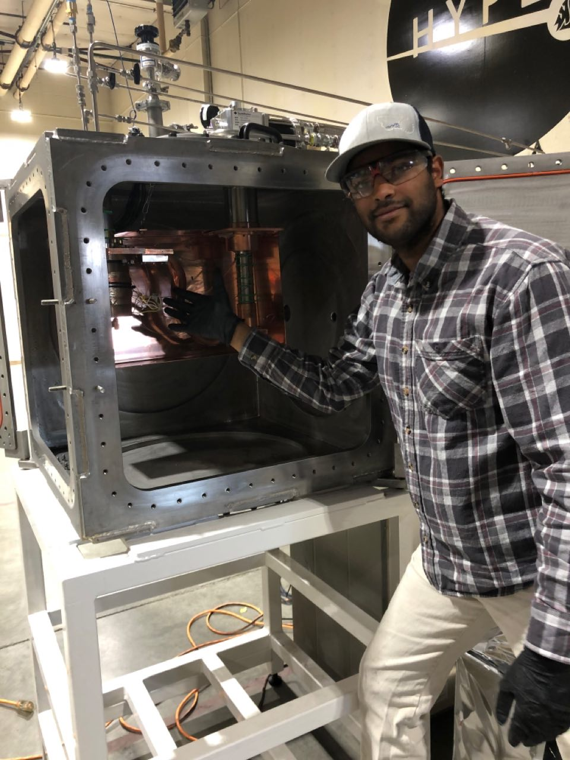
Presented by Matthew Shenton, CTO CryoCowboys LLC and PhD Candidate, Mechanical Engineering, Washington State University
Abstract:
Energy independence is defined as all energy requirements for an enterprise (farm, business, community) being produced and utilized onsite. A foundational energy carrier is required which can be generated and stored for long periods of time. Hydrogen is one of the most promising fuels for future economies with the highest gravimetric energy of any fuel. However, an engineering challenge is increasing the volumetric energy density through liquefaction at cryogenic temperatures. Vaporization of liquid hydrogen during storage and transportation at cryogenic temperatures reduces the viability of hydrogen due to the boil-off losses. Innovations in cryogenic refrigeration systems are imperative to achieving zero boil-off storage and energy independence with cryogenic hydrogen. Hydrogen thermoacoustic instabilities are a promising opportunity for cryocooler development which improves upon existing regenerating refrigeration cycles utilizing a porous medium. Pressure oscillations can spontaneously excite resonators in the presence of a large temperature gradient, and the acoustic power generated can be used to drive pulse-tube cryocoolers. Thus, a combination of a hydrogen thermoacoustic engine and refrigerator produces autogenous cryocooling with no moving parts. This discussion presents the investigation on thermoacoustic instabilities with cryogenic hydrogen to construct new devices which can enable the effective storage and use of liquid hydrogen globally.
Biography:
PhD candidate Matthew Shenton will complete his doctoral degree this fall under the direction of Dr. Jacob Leachman and Dr. Konstantin Matveev, researching hydrogen thermoacoustic oscillations. Through a federal grant with the National Science Foundation, Matthew’s research explored producing acoustic power using hydrogen and utilizing that power as the mechanism for refrigeration. Matthew has constructed multiple experimental apparatuses which provided comprehensive fundamental measurements on oscillating hydrogen systems, leading to numerous publications including a textbook chapter detailing cryogenic hydrogen oscillations in a (to be published) multi-researcher collaboration titled The Handbook of Cryogenics. Matthew’s research accomplishments earned him the Klaus and Jean Timmerhaus Award issued to the top U.S. student in cryogenic engineering. Finally, Matthew is a co-founder and Chief Technical Officer of CryoCowboys LLC. His focus is to commercialize hydrogen technologies to achieve energy independence in the agricultural sector.