CHE 598 Seminar: Molecular Storytelling: From Reaction Pathways To Atomistic Structures Of Biochar
About the event
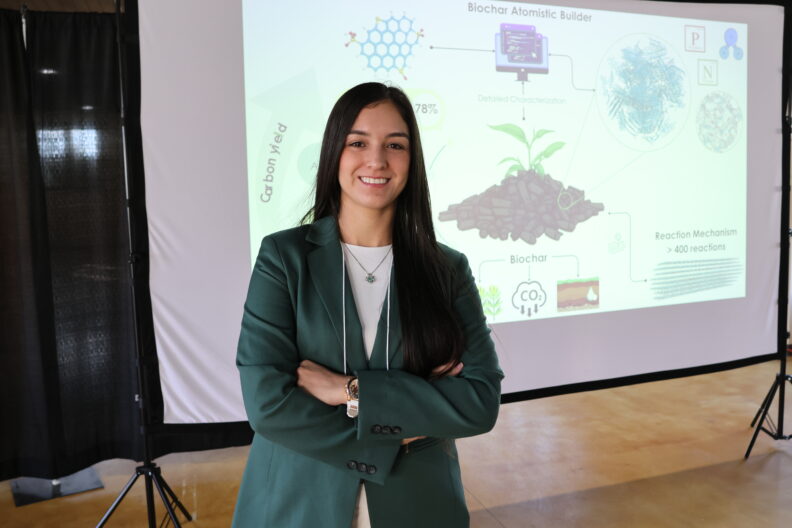
SPEAKER: Dr. Valentina Sierra, Postdoctoral Research Associate, Department of Biological Systems Engineering, WSU
BIOGRAPHY:
Dr. Valentina Sierra-Jimenez is a Chemical Engineer with a Ph.D. in Biological Systems Engineering, specializing in modeling physicochemical processes from the atomic scale to industrial systems. Her research covers chemical and thermochemical transformations such as carbonization, pyrolysis, gasification, and fossil fuel reforming. She integrates cheminformatics and computational chemistry to decode the molecular structures of complex carbon-rich materials, including biochar and bio-oils, and to create data-driven molecular models for advanced simulations.
ABSTRACT:
Understanding biochar at the molecular scale is key to linking its formation mechanisms with its structural properties and functional performance. This seminar will present an integrated research approach that combines experimental characterization, reactive molecular dynamics, density functional theory, and machine learning to explore biochar from its origin in biomass pyrolysis to its final atomistic structure.
We first uncover the reaction pathways that drive the transformation of cellulose-derived oligomers into char precursors, validated through advanced spectroscopic and mass spectrometric techniques. Building on this mechanistic foundation, we develop accurate atomistic models of biochar informed by NMR, FTIR, XPS, and porosity data, refined with computational chemistry tools, and further extended by predictive spectral databases generated through DFT–machine learning integration.
Together, these studies demonstrate how “molecular storytelling” can bridge reaction mechanisms, structure generation, and spectral prediction, offering a powerful path toward designing biochars with targeted functionalities for energy, environmental, and materials applications.