CHE 598 Seminar: Pushing Actinides to the Limit: Bonding and Reactivity at Extreme Oxidation States
About the event
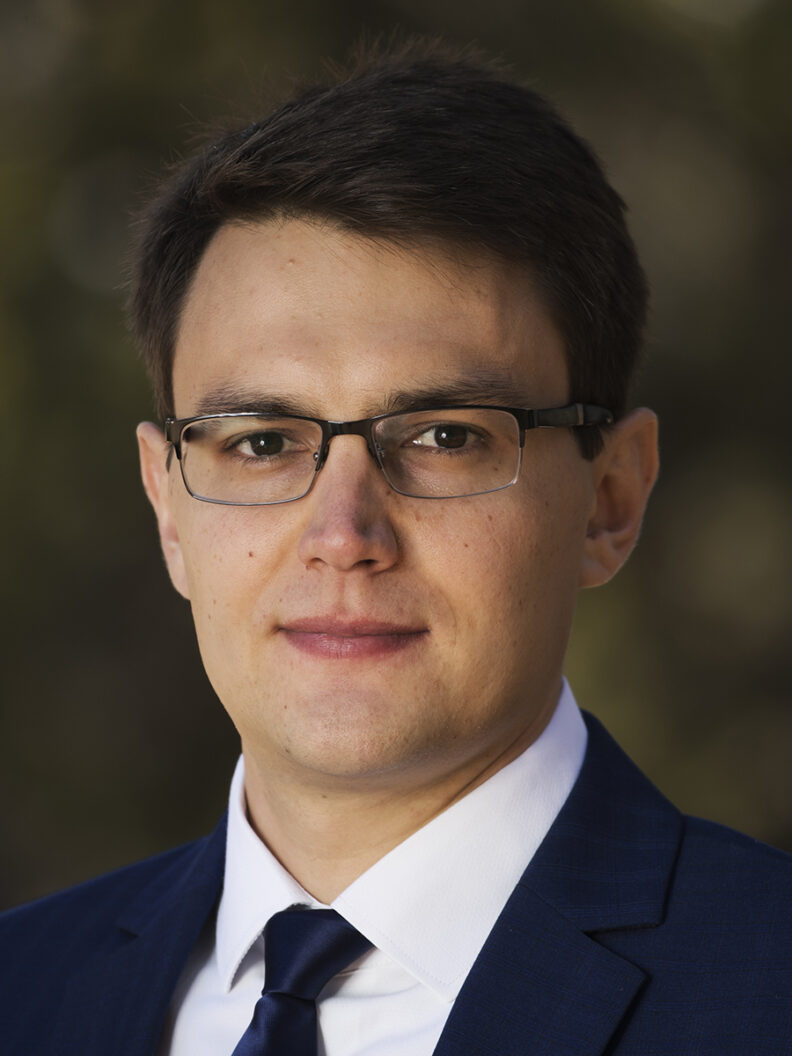
SPEAKER: Dr. Ivan Popov, Assistant Professor, Department of Chemistry, WSU
BIOGRAPHY:
Ivan A. Popov received his B.S. and M.S. with honors in chemistry from RUDN University, Russia, Moscow. In 2011, Ivan moved to the United States to pursue his education under the supervision of Prof. Alexander I. Boldyrev at Utah State University, where he obtained his Ph.D. in Theoretical Physical Chemistry. Ivan joined Theoretical Division at Los Alamos National Laboratory in June 2017 as a Director’s Postdoctoral Fellow, and later in February 2018, Ivan was awarded J. R. Oppenheimer Distinguished Postdoctoral Fellowship. In 2021, Ivan started his independent career as an Assistant Professor at the University of Akron (UA), where he spent three years before joining the Department of Chemistry at Washington State University (WSU). In 2023, Ivan received federal funding from the National Nuclear Security Administration (NNSA) to work in the Transuranic Chemistry Center of Research Excellence (TRUCoRE) to elucidate the electronic structure of actinide compounds in extreme oxidation states and transuranic hydrides. Ivan has also been recognized at the department levels receiving the Buchtel College of Arts and Sciences Early Research and Creativity Award at the UA and Meyer Early Career Launch Fellowship at WSU.
ABSTRACT:
Separating heavy elements remains one of the central challenges in nuclear waste management. A detailed understanding of actinide-ligand interactions across multiple oxidation states is essential for the rational design of selective ligands for nuclear separations. The interplay between actinide-ligand covalency and reactivity at various oxidation states ultimately governs both selectivity and efficiency in these processes. In low-valent actinide complexes, enhanced metal-center reactivity requires sterically demanding ligands that can also act as electron reservoirs to accommodate excess electron density. Deconvoluting the electronic structure of such species is therefore critical for rational ligand design. However, the energetic proximity of the actinide 5f and 6d manifolds to ligand-based antibonding orbitals makes this task non-trivial, as strong metal-ligand electron delocalization blurs oxidation-state assignments while also enabling unusual reaction pathways. In contrast, at high oxidation states, the actinide 5f orbitals are progressively stabilized with increasing oxidation state and atomic number, leading to substantial mixing with ligand orbitals and enhanced covalency. Improved orbital energy matching shifts the balance between overlap-driven and energy-degeneracy-driven covalency, giving rise to divergent reactivity patterns in later actinides and controlling thermodynamic driving forces such as pKa, bond dissociation free energies, and redox potentials. In this talk, I will present collaborative theoretical and experimental studies that elucidate these relationships between covalency and reactivity in low-valent uranium-arene and high-valent actinide-imidophosphorane complexes.