The School of Mechanical and Materials Engineering Seminar Series, “Neural Operators Beyond Data: Physics, Generalization, and Trustworthy Predictions” Presented by Dr. Somdatta Goswami
About the event
Neural Operators Beyond Data: Physics, Generalization, and Trustworthy Predictions
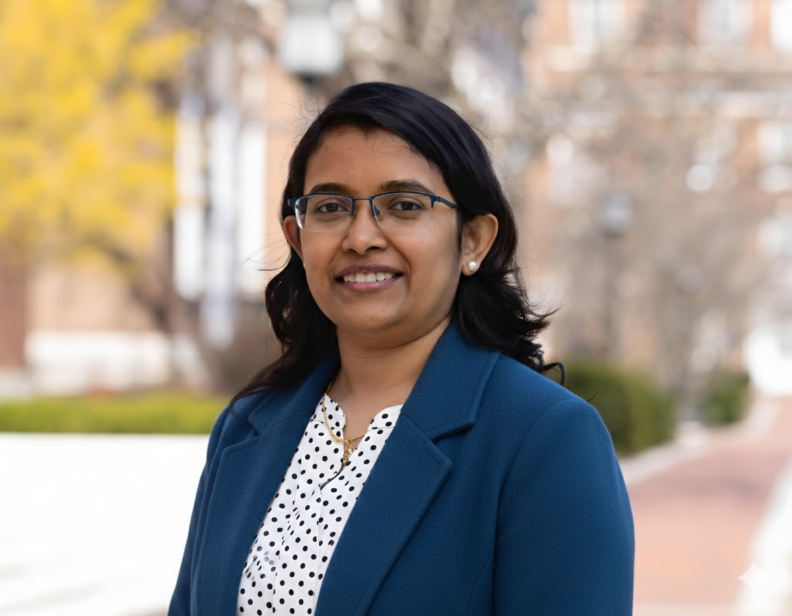
Presented by Dr. Somdatta Goswami, Assistant Professor, Department of Civil Systems Engineering, John Hopkins University
Abstract:
High-fidelity simulations of complex physical systems – from atmospheric flows and plasma instabilities to fracture and reactive transport – are essential but often too expensive for large-scale analysis and real-time decision-making. What if simulations that take days could be reduced to seconds, without sacrificing physical reliability? This talk explores how neural operators are enabling a new class of fast, physics-aware surrogates that learn mappings between function spaces rather than individual solutions. I will present recent advances toward foundation models for scientific computing, focusing on strategies that improve generalization, stabilize long-horizon predictions, and scale to extreme input–output dimensions, even when physics is partially known or data are sparse. Through examples in atmospheric modeling, reaction–diffusion systems, and complex dynamical processes, the talk highlights hybrid neural–physics frameworks, scalable operator architectures, and physics-regularized learning methods that deliver fast yet trustworthy predictions. The discussion concludes with a vision for neural operators as reusable, transferable building blocks for next-generation scientific discovery and engineering design.
Bio:
Somdatta Goswami is an Assistant Professor in the Department of Civil and Systems Engineering at Johns Hopkins University, with a joint appointment in Applied Mathematics and Statistics and the Data Science and AI Institute. Her research lies at the intersection of scientific machine learning, computational mechanics, and physics-informed modeling, with a focus on neural operators, foundation models for scientific computing, and data-efficient learning of complex dynamical systems. She develops hybrid AI–physics frameworks to accelerate high-fidelity simulations while preserving physical consistency, with applications spanning atmospheric flows, fracture mechanics, and multi-physics systems. Dr. Goswami’s work aims to enable scalable, reliable, and interpretable machine learning tools for next-generation engineering analysis and scientific discovery.