CHE 598 Seminar: Catalytic Interfaces In And Out Of Equilibrium
About the event
This seminar is being hosted by both the Department of Chemistry and the Voiland School of Chemical Engineering and Bioengineering
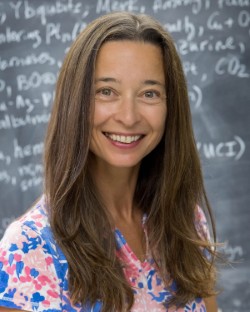
SPEAKER: Dr. Anastassia Alexandrova, Professor, Department of Chemistry and Biochemistry, University of California, Los Angeles
BIOGRAPHY:
Anastassia Alexandrova is a Charles W. Clifford Jr. Professor in Chemistry and Biochemistry, and Professor of Materials Science and Engineering in UCLA. She obtained a B.S./M.S. Diploma with highest honors, from Saratov University, Russia, her Ph.D. in theoretical physical chemistry from Utah State University and was then a Postdoctoral Associate and an American Cancer Society Postdoctoral Fellow at Yale University. Anastassia joined the faculty of UCLA and CNSI in 2010. The focus of her laboratory is theory and computation for design and multi-scale modeling of functional materials: dynamic catalytic interfaces, artificial metalloenzymes, molecular qubits and their assemblies, and quantum materials. Anastassia serves as a Senior Editor of the Journal of physical Chemistry (ACS), and a reviewing editor of the Science magazine (AAAS).
She is a recipient of numerous awards, such as NSF CAREER Award, Sloan Fellowship 2013, DARPA Young Faculty Award 2011, Fulbright Fellowship 2016, and ACS WCC Rising Star Award 2016, 2020 ACS Phys Early Career Award in Theoretical Chemistry, 2021 Max Planck-Humboldt medal, 2023 Gold Shield Faculty Prize, as well as UCLA’s Hanson-Dow award for excellence in teaching 2016, Herbert Newby McCoy award for excellence in faculty research 2016, undergraduate research mentorship award 2018, and 2019 distinguished teaching award (the highest honor for teaching given in UCLA).
ABSTRACT:
Catalytic interfaces in reaction conditions undergo significant morphological changes and often undergo relentless structural and stoichiometric dynamics coupled to the reaction itself. Not surprisingly, successful catalyst formulations are usually found by chance. The talk will show grand canonical modeling of catalytic interfaces, maximally approaching reaction conditions. Simulations, and joint experimental studies, reveal interfacial fluxionality and ongoing dynamics. Statistical ensembles of many catalyst states (geometries and stoichiometries) are populated (1), and jointly control all catalyst properties, from activity and selectivity (2,3) to deactivation propensity (4,5), and operando spectral signatures (6). Swarms of reaction mechanisms are simultaneously in operation. Non-trivial kinetic effects represent a particular new challenge for modeling. Less stable, transient catalyst states can be driving all the catalysis (3). Furthermore, catalysis appears to exploit a non-equilibrium regime (7,8), especially when exposed to extremal stimulation such as bon photolysis. Example systems illustrating this paradigm include supported cluster catalysis for dehydrogenation, hydrogen evolution, and CO2 electroreduction reactions.